
Design thinking can be leveraged as a business practice when shifting focus towards what people need, to observe them in their natural environment, to understand their lives, develop empathy, and uncover latent needs.
"A lot of times people don't know what they want until you show it to them"
— STEVE JOBS
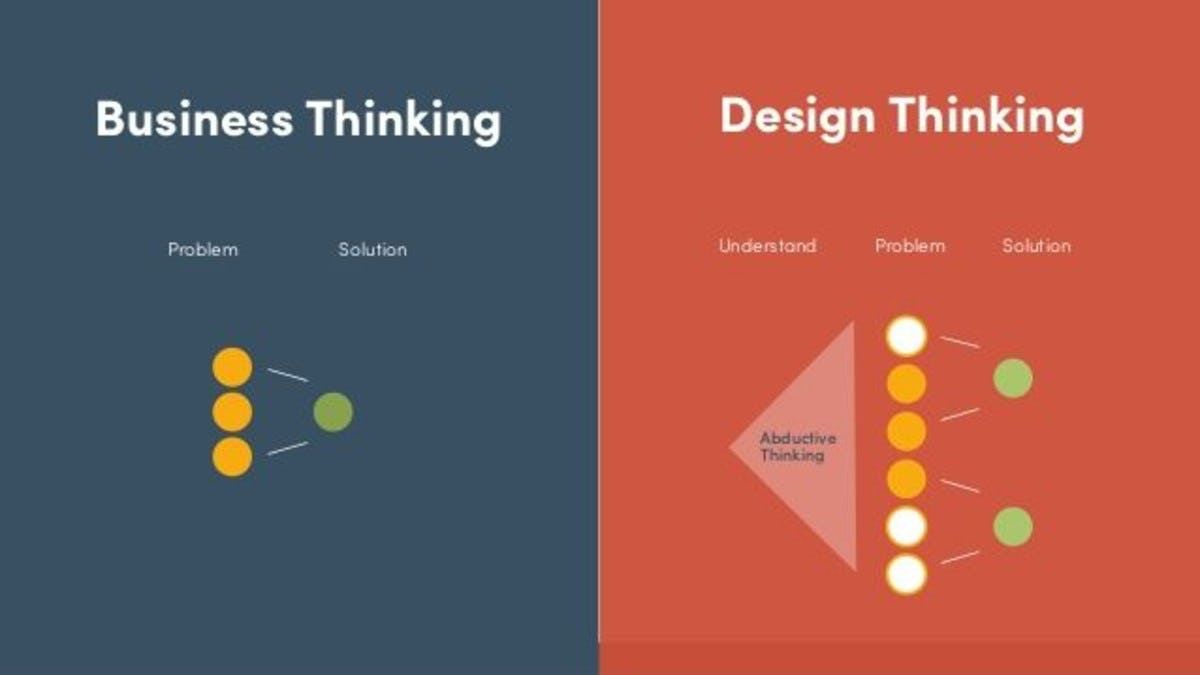
Design thinking as a practice
A mindful practice of designing, developing and delivering products or services by:
- Focusing on the customer - Understand their behaviour (what, when, where, why, how)
- Establishing clear objectives - Aligned to customer needs (not just business goals)
- Tapping into creativity - Encouraging collaboration and dialogue in the design and development phase
- Rapid development and iteration - Embracing failure as an option
- Listening to customer feedback - Refining solutions to best meet the needs of your customers
Design thinking as a method
Human-centered design involves a different starting point in the creation process. When evaluating new ideas, instead of asking "Can it be done?" or "Will it make money?", a design thinking approach forces you to first address what people need. It's about observing people in their environments to understand their lives, develop empathy, and uncover latent needs (anthropology). Good methods include co-design sessions, user research, interviews, and more.
Design thinking as a mindset
This brooches the topic of how to look at challenges around us. It is important to look at the world with a fresh sense of curiosity. Be a keen observer and pay close attention to the finer details. Frequently question why things are the way they are, or why people behave the way they do. Never accept a way of life purely through comfort and familiarity. A strong sense of empathy is also key in understanding the people you are designing for and seeing the world from their perspective. Challenging your assumptions about the status quo to explore: "How can this be done better?"
A good example of adopting this mindset is through this exercise. When tasked to draw an image of gifts, most people would draw box shaped presents. However, in reality people rarely ever give and receive gifts which conform to a box. Similarly, it's more relevant to try drawing a gift which you have actually received. Through this same thinking, there is a need to integrate design thinking into thought processes and business plans to ensure they are relevant and rightfully serve a need.

Solonia shares some valuable tools to enable design thinking. Visualisation or visual thinking pushes us beyond words to think nonverbally. Mind mapping is used to connect ideas, categorise them, and look for patterns and insights for key design criteria. Journey mapping traces the customer's "journey" when receiving a service, focusing on emotional highs and lows. Value chain analysis understands how an organization interacts with value chain partners to produce, market and distribute new offerings. Rapid prototyping allows us to make abstract new ideas tangible to potential partners and customers.
It is important to note that what we call a "problem" is often more a symptom of an underlying cause. When we dive in too quickly to fix a symptom, the effect will eventually come back or happen again. Instead, we need to address the root cause to create innovative solutions and design for change.
— SOLONIA TEODROS
*The Change School is an institution for embracing and navigating through change. They have enabled 1,000 plus people using products and tools, transformational experiences and online courses.